
Much of the work we call “using AI” is really context work.
Before a useful draft, plan, review, or decision can happen, someone has to explain what the product is, who it is for, what stage it has reached, which claims are supported, what changed recently, and what must not be exposed or exaggerated.
Then the next conversation starts with another blank prompt and much of that explanation happens again.
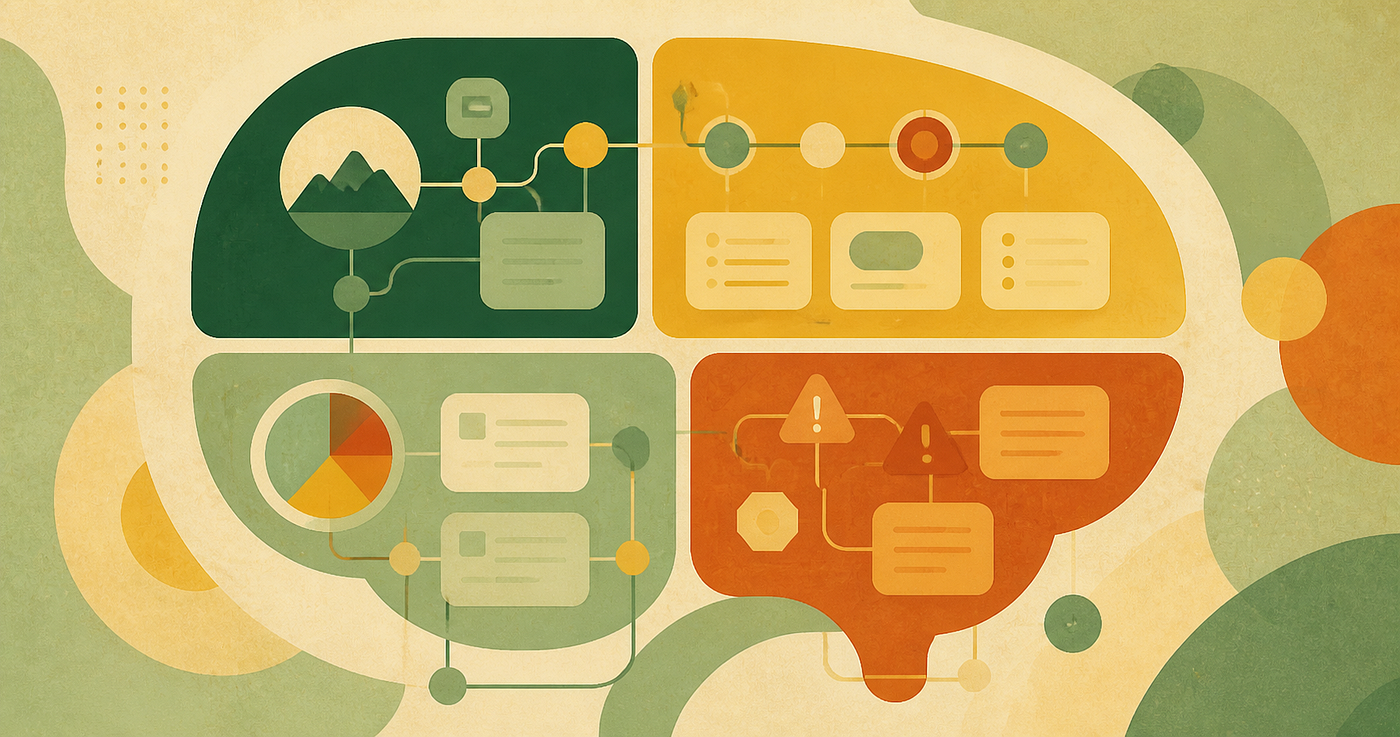
I have been thinking about a project brain as a practical alternative: maintained, structured context that a product can serve to an authorized AI tool when the work needs it.
It is not a giant prompt and it is not an attempt to store everything. It is a small body of durable product knowledge with clear boundaries.
What belongs in a project brain
The useful fields are less mysterious than the name suggests.
A project brain might include:
- what the product does;
- how it should be positioned;
- who needs it and in which situation;
- its current stage;
- capabilities that can be demonstrated today;
- important limitations;
- voice and tone;
- claims or topics that should be avoided;
- current goals;
- working beliefs and campaign ideas;
- processed source material and observations;
- outcomes from earlier work.
The value comes from keeping these categories distinct.
“The product is meant to help with this” is different from “people are already using it successfully.”
“Released” is different from “validated.” A roadmap idea is different from a shipped capability. A project brain can preserve those distinctions so the next piece of work starts from a more honest baseline.
Current state matters more than polished positioning
Marketing context often drifts toward the version of the product we want to exist.
That is understandable. Positioning is partly about direction. But an AI system that only sees the aspiration can produce confident copy that outruns reality.
A maintained brain can hold both:
- the durable point of view behind the product;
- the current, sometimes awkward state of the actual work.
For an independent product, that might mean recording that a public preview exists but meaningful usage still needs validation. It might mean a released tool is looking for awareness rather than claiming established demand. It might mean real recurring use exists while exact metrics remain private unless approved for a specific post.
Those details make the output less dramatic and more trustworthy.

Evidence should travel with the instruction
A reusable system prompt can describe a voice. It cannot prove that a feature shipped last week or that a claim is still current.
That requires evidence: source notes, release records, screenshots, processed documents, saved outcomes, or an operator’s explicit direction. A project brain becomes more useful when it can point to those sources rather than flattening them into one block of prose.
This also improves review. Instead of asking only “Does this sound good?” the operator can ask:
- Which part comes from the durable positioning?
- Which part comes from a current source?
- Which part is an inference?
- Which claim still needs validation?
The goal is not perfect provenance for every sentence. It is to make unsupported confidence easier to notice.
Serve the context where the work happens
Keeping good project notes is useful on its own. The larger opportunity appears when the product can serve the relevant context through a typed interface.
An authorized tool can request the current project snapshot before drafting a campaign, reviewing a profile, or planning an update. It can receive the same fields and evidence that the product itself uses. It can then return a proposal in a structure the product knows how to validate and store.
MCP is a good fit for that pattern because it gives the context and actions explicit names and schemas. The project brain stays owned by the product rather than being copied into every new chat.
The flow becomes:
- Read the current brain and evidence.
- Prepare a bounded proposal.
- Save it as a draft or revision.
- Review it in the product’s interface.
- Apply or publish only through the product’s normal controls.
The model contributes synthesis. The product keeps authority over state and consequences.
A brain should not become a mythology
The term can sound grander than the implementation needs to be.
A project brain is not omniscient memory. It does not automatically know whether a launch succeeded, whether a user is happy, or whether a private note is safe to publish. It can be incomplete, outdated, or internally inconsistent.
That means it needs ordinary product maintenance:
- visible fields rather than hidden lore;
- timestamps and sources where freshness matters;
- an operator who can correct it;
- clear separation between facts, beliefs, goals, and ideas;
- audit history for meaningful changes;
- limits on what downstream tools may read or do.
It should reduce repeated explanation, not remove responsibility.
Better context across several interfaces
The most interesting effect is consistency across different surfaces.
The same maintained context can help with a social draft, a product page review, a support response, a roadmap discussion, or a release note. Each workflow still needs its own rules and its own human judgment, but the product does not have to reinvent its identity every time.
For a solo builder working across several products, that matters. The difficult part is often not producing another paragraph. It is keeping the paragraph connected to the real product record while the work keeps changing.
A project brain gives that connection somewhere to live.
Start small and keep it honest
The first version does not need an elaborate knowledge graph.
Start with a dozen fields that answer practical questions. Add source material only when it improves a real workflow. Record outcomes when they can change the next decision. Expose the context through narrow, read-only tools before adding write actions. Keep proposal, approval, and execution separate.
Most importantly, update the current stage when reality changes.
The benefit is not that the AI suddenly understands the whole project. The benefit is that it begins each task with less guessing, less repeated prompting, and a clearer picture of what the product can honestly say and do.
That is not a replacement for thinking. It is infrastructure that leaves more room for it.